
Water Testing Lab in Lahore
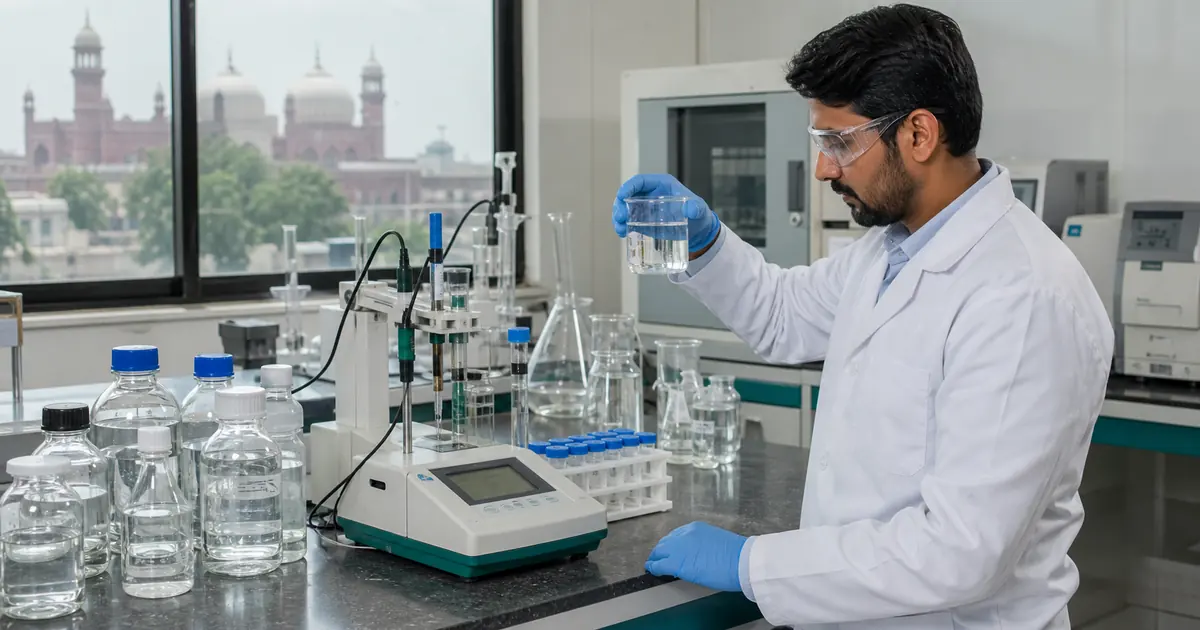
Choosing a water testing lab in Lahore should involve more than comparing price and turnaround time. A laboratory report may ultimately be used to make a drinking-water safety decision, investigate an RO or process-water problem, demonstrate environmental compliance, satisfy a customer or buyer requirement, or support an audit.
The laboratory therefore needs to be selected around the exact sample, parameters, analytical methods, reporting purpose and required accreditation status. If you are searching for a water testing lab in Lahore, this guide explains what to verify before submitting a sample, how ISO/IEC 17025 accreditation should actually be interpreted, which questions to ask a laboratory, and how to build a testing scope that produces useful rather than merely impressive-looking results.
For customers who already know their testing requirement, Envi Tech AL provides dedicated water testing laboratory services and Lahore-based coordination through its environmental testing laboratory in Lahore.
Quick answer: how should you choose a water testing lab in Lahore?
A reliable laboratory should be able to show you, before testing begins:
- which laboratory location will perform the analysis;
- whether the exact sample matrix and requested parameter are inside its current accredited scope;
- which analytical method will be used;
- what sampling, preservation and transport conditions are required;
- which regulatory, health, buyer or process specification the results will be compared against;
- the expected reporting format and turnaround time; and
- how the authenticity of the final report can be verified.
The key principle is simple: do not select a laboratory only because it says “ISO 17025 accredited.” Confirm that the particular location + matrix + parameter + method relevant to your sample is covered by the current published accreditation scope.
Why professional water testing matters
Water that appears clear is not automatically suitable for drinking, manufacturing, food preparation, healthcare use or an industrial process. Appearance alone cannot establish its microbiological or chemical quality.
The testing requirement also changes according to the decision being made. A drinking-water sample, bore-water investigation, reverse-osmosis plant check, boiler-water assessment and industrial wastewater sample should not automatically be sent for the same parameter package.
This is where a competent water testing laboratory in Lahore adds value: the laboratory should help define the analytical scope before analysis rather than simply processing whatever parameters happen to be requested.
For example, a facility may need testing to answer one of several completely different questions:
- Is this water suitable for drinking?
- Is an RO plant producing the expected water quality?
- Why is scaling occurring in a boiler or cooling system?
- Does groundwater contain elevated salts or selected contaminants?
- Does wastewater comply with an applicable discharge requirement?
- Does a buyer, customer, certification body or auditor require specified test evidence?
- Has treatment performance improved after corrective action?
The correct parameter set follows the question. Testing first and deciding what the data means later is usually a poor technical approach.
ISO/IEC 17025: what accreditation actually tells you
ISO/IEC 17025:2017 is the international standard addressing the competence, impartiality and consistent operation of testing and calibration laboratories.
However, accreditation is scope-specific. It should never be interpreted as meaning that every analysis offered by an organization, at every location, using every method, is automatically accredited.
This distinction is especially important when comparing water quality testing labs in Lahore.
Ask the laboratory these four questions
- Which laboratory is performing my test?
- Is my sample matrix included? For example, water, wastewater or another specific material.
- Is the exact parameter included?
- Is the analytical method included in the current scope?
If any of these differ from the published accreditation document, ask the laboratory to explain the status clearly before the work begins.
Customers comparing laboratories can also review Envi Tech AL’s dedicated guide to selecting an ISO/IEC 17025 accredited environmental laboratory and its consolidated certifications, approvals and laboratory credentials.
Envi Tech AL Lahore laboratory: what the official PNAC scope currently shows
Pakistan National Accreditation Council’s current accreditation document identifies Envi Tech AL, LAB-347, at 87-E Madina Heights, Office A/30-31, 8th Floor, Maulana Shaukat Ali Road, Johar Town, Lahore.
The PNAC document states that accreditation was first granted on 22 September 2025, that the laboratory complies with ISO/IEC 17025:2017, and that the accreditation is stated as valid until 21 September 2028, subject to regular surveillance and current PNAC status.
Customers should verify the latest version directly from the official PNAC LAB-347 accreditation document before relying on accreditation for procurement, audit or regulatory purposes.
Water and wastewater parameters currently listed in LAB-347
| Parameter | Published method reference |
|---|---|
| pH | APHA 4500-H B, 24th Edition (2023) |
| Total Dissolved Solids (TDS) | APHA 2540-C, 24th Edition (2023) |
| Total Hardness as CaCO3 | ASTM D1126-17 |
| Sulphate | APHA 4500-SO42- E, 24th Edition (2023) |
| Alkalinity | APHA 2320-B, 24th Edition (2023) |
| Calcium | ASTM D1126 / APHA 3500-Ca B |
| Turbidity | USEPA 180.1 / APHA 2130 B |
| Chlorides | APHA 4500 Cl-B, 24th Edition (2023) |
| Nitrate | APHA 4500 NO3-E, 24th Edition (2023) |
Important: this table should not be interpreted as Envi Tech AL’s entire analytical capability. It identifies the water/wastewater parameters shown in the current published LAB-347 accreditation scope. A laboratory may offer additional analyses, but their accreditation status must be confirmed separately.
If your requirement includes microbiology, metals, organic parameters or any test not shown in the current scope, ask the laboratory to state clearly how the parameter will be handled and whether the reported result will carry applicable accreditation.
Start with the purpose — not a generic “complete water test”
One of the most important questions a competent water analysis lab should ask is: What decision will this report support?
Drinking and potable water
Drinking-water testing generally requires consideration of microbiological, physical and chemical risks. The actual panel should be selected according to the source, treatment system, distribution conditions, history of the supply and applicable requirement.
The World Health Organization’s current Guidelines for Drinking-water Quality: Fourth Edition incorporating the first, second and third addenda were published on 17 June 2026. WHO’s framework emphasizes risk-based water safety management from catchment to consumer rather than relying on laboratory testing alone.
WHO guideline values are an important scientific reference, but they should not automatically be treated as a substitute for applicable Pakistani regulatory requirements, customer specifications or project-specific acceptance criteria.
RO plant water
An RO system should be assessed according to what the plant is intended to achieve. Depending on the application, useful measurements may include feed-water and permeate characteristics such as TDS, conductivity, hardness, alkalinity, chloride, turbidity and other application-specific parameters.
Where RO water is used for drinking, microbiological and health-related requirements may also need to be considered. Where it is used in manufacturing, the process or product specification may be more relevant than a generic drinking-water panel.
Bore and groundwater
Groundwater chemistry can vary by location, geology, nearby land use and potential contamination sources. Testing may therefore require a wider risk-based scope than simply measuring TDS.
If the purpose is drinking, agricultural, process or treatment-system design, inform the laboratory before selecting the parameter package.
Industrial process and utility water
Boilers, cooling towers, textile processes, food manufacturing, pharmaceutical operations and other industrial systems have different water-quality requirements.
Hardness, alkalinity, conductivity, silica, chlorides, iron and other parameters may be technically important depending on the process. The correct limits should normally come from plant design requirements, process specifications, equipment manufacturers, customer requirements or an applicable standard.
Wastewater and industrial effluent
Wastewater testing should be designed around the applicable discharge route, environmental approval, permit condition or regulatory standard. Typical wastewater investigations may involve pH, TDS, TSS, BOD, COD, oil and grease, selected metals and other industry-specific contaminants.
Do not assume that every wastewater parameter offered by a laboratory falls within the same accredited scope. Confirm the status parameter by parameter.
Organizations requiring wider environmental support can also review Envi Tech AL’s analytical laboratory services and environmental consultancy services.
Which parameters should a water testing laboratory check?
There is no scientifically defensible universal “one-size-fits-all” water testing panel. The correct selection depends on the source and intended use.
| Water / requirement and decision | Parameters commonly considered |
|---|---|
| Drinking / potable waterPrimary decision: Health and suitability | Microbiological indicators, pH, turbidity, TDS, hardness, nitrate, chloride, sulphate, fluoride and risk-relevant metals |
| RO drinking waterPrimary decision: Treatment performance and drinking-water quality | TDS, conductivity, pH, turbidity and microbiological parameters where relevant |
| Bore / groundwaterPrimary decision: Suitability and treatment requirement | General chemistry plus source- and location-specific contaminants |
| Boiler / cooling waterPrimary decision: Scaling, corrosion and operational control | Hardness, alkalinity, conductivity, silica, chloride, iron and system-specific parameters |
| Process waterPrimary decision: Product and process control | Parameters defined by process, product, buyer or equipment specification |
| Industrial wastewaterPrimary decision: Compliance and treatment performance | Parameters defined by discharge standard, environmental requirement and process characteristics |
A professional water quality testing lab in Lahore should therefore be willing to discuss why a parameter is being tested rather than merely offering the largest available package.
Sampling can determine whether an excellent laboratory produces a useful result
Analytical accuracy cannot correct a badly collected, contaminated, incorrectly preserved or unrepresentative sample.
Before sampling, confirm:
- where the sample should be collected;
- whether the point should be flushed first;
- which container is required;
- whether a preservative is required;
- required sample volume;
- temperature or cooling requirements;
- maximum permitted holding time;
- sample identification and labelling;
- chain-of-custody requirements; and
- transport time from the site to the laboratory.
This becomes especially important for microbiological analysis and parameters that can change after sampling.
Client-collected sample or laboratory sampling?
For informal screening, a customer-collected sample may sometimes be appropriate if the laboratory provides correct instructions. For compliance, buyer, investigation or legally important work, professionally controlled sampling and documented chain of custody may provide substantially stronger evidence.
Envi Tech AL’s Lahore team coordinates water and wastewater testing and field requirements through its Johar Town Lahore operation.
Why a cheap water test can become an expensive mistake
The lowest quotation is not necessarily the lowest-cost decision.
A test may need to be repeated if the wrong parameters were selected, a sample exceeded its holding time, the buyer required an accredited method that was not confirmed, the regulatory comparison basis was incorrect, or the report does not contain enough traceability for its intended purpose.
A technically stronger quotation should therefore identify the scope clearly enough that you can compare laboratories on equivalent work.
Compare quotations line by line
Check whether competing quotations include the same:
- number of samples;
- parameters;
- test methods;
- accreditation status;
- sampling service;
- transport or mobilization;
- report format;
- regulatory comparison;
- turnaround time; and
- taxes and other charges.
A quotation offering ten parameters cannot meaningfully be compared with another offering thirty unless both are intended to answer the same technical question.
What should you expect from a professional water testing report?
A useful laboratory report should allow the reader to understand what was tested, which sample the result represents, how it was analysed and—where applicable—what comparison basis was used.
Depending on the scope and purpose, useful information may include:
- unique report identification;
- customer and sample identification;
- sample source or location;
- sampling or receipt date;
- analysis dates where applicable;
- parameter names and units;
- analytical methods;
- measured results;
- applicable comparison values where agreed;
- accreditation marking/status where applicable;
- authorized review or approval; and
- report authenticity or verification information.
Envi Tech AL provides a dedicated test report verification portal through which supported reports can be checked using the relevant report details.
Do not confuse detection with interpretation
A laboratory result is a measurement. The meaning of that measurement depends on the correct comparison framework.
For example, the same water may be evaluated differently when intended for:
- human consumption;
- an industrial cooling system;
- a boiler;
- a textile process;
- food or beverage manufacturing;
- pharmaceutical use;
- irrigation; or
- environmental discharge.
Before requesting testing, tell the laboratory exactly how the water is being used and what decision the report needs to support.
10-point checklist for selecting a water testing lab in Lahore
-
Verify the laboratory’s identity and physical location.
Confirm which laboratory will actually perform the analysis rather than assuming the nearest office and testing laboratory are the same thing.
-
Check the current ISO/IEC 17025 accreditation document.
Use the issuing accreditation body’s current record rather than relying only on a logo displayed on a website or quotation.
-
Verify the exact accredited scope.
Match your sample matrix, parameter and method against the published scope.
-
Check applicable EPA or regulatory status.
If the report is intended for environmental compliance, ask whether the laboratory holds the relevant current regulatory certification and whether any conditions apply.
-
Define the purpose before choosing parameters.
Drinking-water safety, wastewater compliance and boiler-water troubleshooting are different technical assignments.
-
Confirm the sampling plan.
Ask about containers, preservation, holding times, transport conditions and chain of custody before collecting the sample.
-
Ask which analytical methods will be used.
A professional quotation should allow technically important method requirements to be confirmed before analysis.
-
Confirm turnaround realistically.
Some analyses have method-defined preparation, reaction or incubation requirements. An unusually fast promise should not override method integrity.
-
Review the reporting format.
Make sure the final report will contain the information required by management, regulator, buyer, auditor or consultant.
-
Verify the final report.
Where authenticity matters, use the laboratory’s report-verification mechanism or contact the issuing laboratory directly.
Punjab EPA status is another important Lahore due-diligence check
Where water or wastewater testing is intended to support environmental compliance in Punjab, customers should verify the current regulatory status relevant to the assignment.
Punjab Environmental Protection Agency currently publishes an Envi Tech AL environmental laboratory certification record covering 2025–2028. Customers using the evidence for regulatory, procurement or audit purposes should review the current issuer document and its conditions rather than relying solely on a website statement.
Review the official Punjab EPA Envi Tech AL laboratory certificate.
The latest WHO drinking-water guidance: an important 2026 update
Water-testing articles frequently continue to reference older WHO editions. The current WHO publication is the Guidelines for Drinking-water Quality, Fourth Edition incorporating the first, second and third addenda, published on 17 June 2026.
The updated WHO guidance reinforces a broader risk-management approach covering health-based targets, water safety planning and independent surveillance. This matters because a laboratory test is only one component of managing drinking-water safety.
For organizations responsible for buildings, hospitals, hotels, factories, housing facilities or water-treatment systems, periodic testing should therefore form part of a controlled water-management process rather than being treated as an isolated annual certificate.
Choosing Envi Tech AL for water testing in Lahore
Envi Tech AL supports Lahore and Punjab customers with environmental testing, water and wastewater analysis, field coordination, consultancy and compliance-focused reporting.
The Lahore laboratory is located at:
Envi Tech AL – Lahore87-E Madina Heights, Office A/30-31, 8th Floor
Maulana Shaukat Ali Road, Johar Town
Lahore, Pakistan
Telephone: +92 42 32296099
Email: info@envitechal.com
A scope-first testing workflow
Rather than beginning with a generic laboratory package, the recommended process is:
- Define the water source and intended use.
- Define why the report is required.
- Identify the applicable standard, regulatory requirement or buyer specification.
- Select relevant parameters.
- Confirm laboratory location, method and accreditation status.
- Agree sampling and transport requirements.
- Perform analysis.
- Technically review and issue the report.
- Use the result to make the intended operational, safety or compliance decision.
This approach helps prevent unnecessary parameters while reducing the risk that an important one is omitted.
Learn more about Envi Tech AL’s complete water testing laboratory services, review laboratory accreditations and certifications, or send your testing requirement to the technical team.
Frequently asked questions about water testing labs in Lahore
Authoritative references
- Pakistan National Accreditation Council — Envi Tech AL LAB-347 Accreditation Document
- Pakistan National Accreditation Council — Active Testing and Calibration Laboratories
- Punjab Environmental Protection Agency — Envi Tech AL Environmental Laboratory Certificate 2025–2028
- World Health Organization — Guidelines for Drinking-water Quality, Fourth Edition incorporating the First, Second and Third Addenda
- International Organization for Standardization — ISO/IEC 17025:2017