
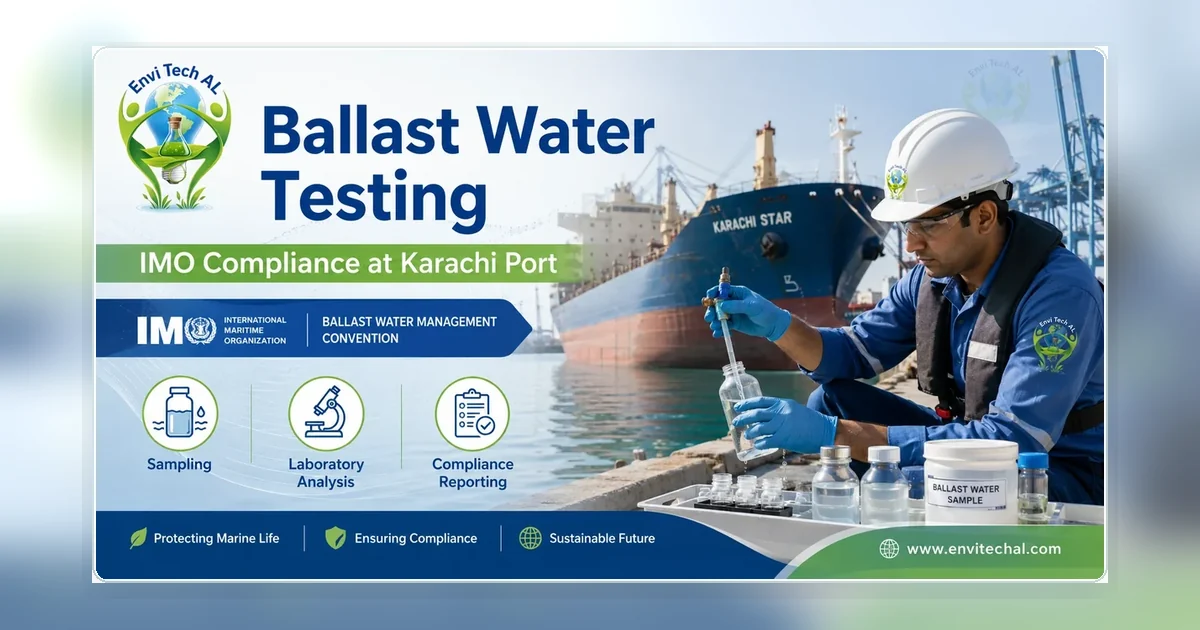
Ballast Water Testing & IMO Compliance at Karachi Port
Maritime Compliance
Ballast Water Testing for Karachi Port Calls
Ballast water testing should be scoped before a vessel call, because the report must match the IMO ballast water management context, the sampling access window and the decision a shipping agent needs to support.
Key Takeaways for Ballast Water Testing
Define the decision first
Confirm whether the vessel needs indicative screening, detailed ballast water analysis, documentation support or a staged route before mobilisation.
Protect sample identity
Vessel name, IMO number if available, tank or line identity, sampling point, time and chain of custody must be recorded cleanly.
Keep claims conservative
A laboratory report is evidence for the sample tested. It is not a vessel certificate, class approval or guaranteed port state control outcome.
Use primary context
The IMO BWM Convention framework should guide the scope, but vessel, flag, class, customer and authority instructions still need case-specific confirmation.
What Ballast Water Testing Is Meant to Prove
For shipping agents and vessel operators, the practical question is rarely "can we test ballast water?" The better question is what the test must prove, who will read the result and when the evidence must be ready. A quick screen may support an operational conversation. A detailed route may be needed for a formal evidence file, customer query, audit or port-related review.
The International Maritime Organization explains ballast water management through the D-1 exchange standard and D-2 performance standard in its public guidance on implementing the Ballast Water Management Convention. In plain terms, D-1 concerns ballast water exchange away from coastal areas, while D-2 concerns the quality of managed ballast water discharged after treatment or management. Those general references are important context, but they are not a substitute for vessel-specific advice, flag-state instructions, class guidance or port requirements.
That distinction matters in Pakistan. A Karachi Port request may arrive with little notice, yet the report still needs a defensible scope. Ballast water testing Pakistan buyers should avoid vague purchase orders such as "test for IMO". The request should state whether the job is indicative, detailed, pre-discharge, post-treatment, dispute-related or an internal check before a further technical decision.
Scope Selector for Vessel Agents and Owners
A premium testing request is not longer than a weak request; it is simply clearer. The buyer should describe the decision, sampling point and evidence format before the laboratory attends. The routes below help a shipping agent, owner representative or master start the conversation.
Indicative screen
Useful when the vessel team needs a faster operational sense of risk, subject to method limitations and responsible interpretation.
Detailed analysis
Better suited when the report must support a technical evidence file, buyer query, audit trail or documented internal review.
Documentation support
Appropriate when analytical findings must be read beside the ballast water management plan, record book and treatment-system records.
Decision Matrix Before Attendance
| Decision point | What to confirm before attendance | Why it matters |
|---|---|---|
| Purpose | Operational screen, customer evidence, port query, internal verification or formal documentation support. | The purpose decides analysis depth, report wording, limitations and turnaround expectation. |
| Sample identity | Vessel name, IMO number if available, tank or line identity, sampling point and collection time. | Weak sample identity can make a technically sound result difficult to use later. |
| Access window | ETA, berth or anchorage status, gangway access, permit requirements, safety briefing and vessel contact. | Most port sampling failures are logistical, not analytical. |
| Reporting deadline | The latest useful time for preliminary communication and the final signed report. | Unrealistic deadlines can lead to the wrong test route being ordered. |
| Reviewer context | Customer request, inspection note, internal audit question, vessel record or other instruction driving the test. | The report is stronger when it answers the actual review question instead of a guessed requirement. |
Karachi Port Sampling Coordination
Ballast water sampling is a controlled evidence exercise. Before mobilisation, the agent should share vessel schedule, onboard contact, access requirements, safety constraints, tank or treatment-system information and the required reporting deadline. If an inspection, customer request or port state control context is driving the work, the laboratory should see the request wording rather than rely on a verbal summary.
Confirm purpose and access
Agree the reason for testing, vessel contact, safe access route, berth or anchorage status and any permit requirement before dispatch.
Record the sample identity
Capture vessel identity, sampling point, date, time, sample container reference and chain of custody in a form that can be reviewed later.
Match analysis to the decision
Select indicative testing, detailed analysis or a staged approach according to the decision the report must support.
Report limitations plainly
State what was sampled, what was analysed, what was not assessed and how the result should be read with vessel records.
Indicative Testing Versus Detailed Ballast Water Analysis
Indicative testing can be useful when a vessel team needs a faster sense of risk or wants to decide whether further action is needed. Detailed analysis is more suitable when the report must support a formal technical evidence pack. The two routes should not be sold as the same product, and a buyer should not assume that a rapid screen answers every biological, operational or compliance question.
A careful quotation should identify the requested analysis type, method family, matrix, sample count, reporting format and limitations. If a parameter, organism group or interpretation sits outside the agreed laboratory scope, it should be excluded or clearly qualified. That conservative approach protects the agent, vessel operator and laboratory from exaggerated claims.
For broader regulatory orientation, IMO's public ballast water management page explains why untreated ballast water can transfer aquatic organisms and why international controls exist. Use that public context for orientation, then confirm the exact vessel requirement with the responsible party.
What a Professional Report Should and Should Not Claim
It should contain
- Client, vessel and sample identity.
- Date, time, location, tank or line and sampling method note.
- Agreed parameters, method references where applicable, results and reporting limits.
- Clear limitations when a sample does not represent the whole vessel, tank or operating condition.
It should avoid
- Guaranteed compliance language.
- Implied vessel certification or class approval.
- Broad statements about all tanks when only one sample was tested.
- Unsupported promises about port state control decisions.
For port state control discussions, the laboratory report should sit beside the vessel's ballast water management plan, ballast water record book, treatment-system records and any relevant instruction from the owner, customer, class or authority. The evidence becomes stronger when it is part of a controlled file rather than an isolated PDF.
How Envi Tech AL Supports Maritime Clients
Envi Tech AL provides ballast water testing, water and wastewater testing, air and stack emissions testing, noise monitoring, environmental consultancy, equipment calibration and thermal imaging services from Karachi and Lahore. The company fact sheet records ISO/IEC 17025:2017 accreditation, TUV certification, and certification by Sindh EPA and Punjab EPA. For any quotation, ask the team to confirm the exact accredited or approved scope for the requested parameters.
The practical value for maritime clients is coordination. A vessel call may involve the agent, master, chief engineer, owner representative, customer and local stakeholders. Envi Tech AL helps translate urgency into a defined sampling plan, clear report request and restrained explanation of findings. The company's positioning, Precision. Compliance. Trust., is strongest when the report is precise about what was sampled, what was analysed and what the result can responsibly support.
For service context, review Envi Tech AL's ballast water testing services and analytical laboratory services. For enquiries, send the vessel call details through Contact Envi Tech AL so the scope, timing and report route can be checked before mobilisation.
Common Mistakes to Avoid
Ordering vague "IMO testing"
State whether the request relates to D-1 context, D-2 context, treatment performance, customer evidence, audit evidence or another review point.
Leaving sample points unclear
A vague sampling location can make the report difficult to defend even when the laboratory work itself is sound.
Treating a report as approval
A laboratory report supports the evidence file. It does not replace vessel documents, class guidance, flag-state requirements or authority decisions.
Source Method and Verification Date
Regulatory context in this article was checked on 25 July 2026 against public IMO pages on BWM Convention implementation and ballast water management. The article uses those sources for general framework context only. It does not quote paid standards, invent limits, state vessel-specific obligations or promise authority acceptance.
Where a live request involves a specific vessel, customer clause, inspection note, charter requirement or port instruction, treat this article as preparation guidance. Confirm the operative requirement with the responsible authority, flag, class, owner or customer before relying on a test report for a formal decision.
Need a Scoped Ballast Water Testing Plan?
Share the vessel name, ETA, sampling point, requested evidence route and reporting deadline. Envi Tech AL will help confirm a responsible scope for Karachi Port attendance.
Frequently Asked Questions
Who usually requests ballast water testing at Karachi Port?
Shipping agents, vessel operators, owner representatives and maritime compliance teams may request testing when they need analytical evidence for a vessel call, customer query, operational review or port-related discussion.
Is indicative testing the same as detailed ballast water analysis?
No. Indicative testing is generally used for faster screening or operational decisions, while detailed analysis is more suitable for a formal technical evidence file. The right route should be agreed before sampling.
Can a laboratory report guarantee IMO BWM compliance?
No. A laboratory report gives evidence for the sample and scope tested. IMO BWM compliance depends on the vessel, its management system, documents, applicable requirements and the relevant reviewer or authority.
What information should we send before booking?
Share the vessel name, IMO number if available, ETA, access contact, sample point, purpose of testing, required analysis type and reporting deadline. Clear information helps the lab confirm what is feasible.
Reviewed by the Envi Tech AL lab team.